
Will Intuitive Intelligence Define the Future of Work?
A case that as AI outpaces humanity in reasoning ability, certain cultivated forms of intuition will become humanity's edge in the future of work. A longer read for builders and leaders.


Spirit Tech: Field Notes from the Edge is a newsletter written by members of the Spirit Tech Collective (STC). Inspired by the Climate Tech movement, STC’s mission is to 50x the funding and talent flowing into the Spirit Tech sector over the next 10 years, paving the way for greater collective wisdom and flourishing. Our aim with this newsletter is to share the synthesis of our research for feedback as we collectively cultivate the soil to usher in the next wave of Spirit Tech innovation.

How the Role of Human Intelligence Is Changing
The dominant narrative says AI will make human work obsolete. The counter-narrative says humans need to intellectually upskill, learn to think harder and faster with the help of AI. A third increasingly popular view holds that human work will shift toward relational presence, meaning-making and the kind of human-to-human connection that arises through the resonance of living nervous systems and consciousnesses. This view addresses dimensions of the human experience that are beyond the reach of software architecture. We believe that view is right, but incomplete. There are unique dimensions of human intelligence that can contribute generatively to innovation, creativity, building, and problem-solving, ones that the AI architectures we are scaling don’t have the means to access. This piece makes the case for what those understudied dimensions of intelligence are, why they matter economically, and why they may represent the most consequential opportunity of our time for the development of human consciousness.
The future of AI, which dimensions of human intelligence will matter most alongside it, and the mechanisms behind them, are all uncertain. We are publishing this essay to input a new possibility into the discussion. Pushback, additions, and corrections welcome.
AI is rapidly becoming a superior intellect. Intellect is but one dimension of intelligence that is frequently confused with intelligence more broadly. We use it here more precisely to mean the capacity for deliberate reasoning, including analysis and synthesis. It is this capacity that AI is mastering. It’s learning to reason across more and more domains at superhuman speed, as well as perform statistical pattern recognition at that same level. This shouldn’t surprise us: AI is trained overwhelmingly on the written output of human intellects and chains of thought expressed across the internet. The architectural breakthroughs driving AI’s most dramatic recent advances are optimized for step by step reasoning. It is in a quite direct sense an engineered distillation of the human intellect, and it’s on track to make the human intellect obsolete.
This doesn’t make humans irrelevant. It changes what humans are for and with it, the skills humans need to develop to be productive.
Jensen Huang, CEO of NVIDIA, recently said on the podcast A Bit Personal that the old definition of smart as being technically capable and analytically sharp, is exactly the kind of intelligence AI handles most easily. What remains genuinely smart, he said, includes the ability to infer the unspoken, see around corners, and sense problems before they fully reveal themselves.
There is far more processing happening in the human system than what shows up in conscious, rational thought. Our bodies, our emotions, our pattern-sensing intuition are all processing (and predicting) incoming information from our senses all the time (much of it subconsciously), and may even utilize information received through human senses beyond those science has yet to map. The intellect is the narrow slice of all this human processing we’ve learned to articulate and trust. But beneath and beyond it, other dimensions of intelligence are constantly at work, registering information through the body, through feeling, through forms of knowing we can’t fully trace or explain.
Some of history’s most celebrated breakthroughs come from intuitive leaps. As Einstein put it: “The mind can proceed only so far upon what it knows and can prove. There comes a point where the mind takes a leap, call it intuition or what you will, and comes out upon a higher plane of knowledge, but can never prove how it got there. All great discoveries have involved such a leap.” (Life Magazine, 1955) Nikola Tesla described it similarly. He’d been struggling analytically for months with the design of his revolutionary AC motor. Then, during a walk in a Budapest park, the complete solution appeared to him in a flash. The formal engineering came later, but the breakthrough itself arrived whole. Tesla described his mind as a “receiver” tuning into something beyond his own thought. Where does this leap come from?
Examples like these point toward a possible limit of AI. AI’s training surface for learning the mechanisms of intelligence is largely limited to what humans have consciously articulated into text, code, and data. When an intuitive signal or idea simply lands, the complete inner process steps that produced it (and any underlying subconscious sense data it builds upon) are never consciously accessed by our minds. Therefore, they are never articulated and captured on the web for AI to learn to replicate. And if that processing draws on information from senses that AI hardware doesn’t have, replication is not a matter of better training data or architecture.
Mainstream institutions are beginning to recognize this. A recent Harvard essay on “Intuition in the Age of AI” argues that as computation becomes abundant, intuitive discernment becomes a defining human skill. But Harvard’s framing still largely reduces intuition to tacit pattern recognition. The deeper forms of intuition that we will explore may represent a far more durable and consequential human edge. And with each advance in AI capability, the edge shifts further toward these deeper forms.
Intuition: Intelligence Beyond the Intellect
Before going further, it is worth defining what we mean by intuition. Often reduced to gut feeling, we use the term here in a broader sense to refer to forms of human intelligence, processing, and knowing that operate outside conscious, deliberate, rational thought. Where the intellect derives outputs step by step from explicitly known information, intuition operates through felt sense and leaps. What we call intuition here overlaps with what others call creative leaps, inspiration, eureka/aha moments, taste, instinct, trans-rationality, or wisdom.
The HeartMath Institute has identified three types of intuition, forming a spectrum from most to least explainable by known mechanisms:
Types of intuition:
Implicit knowledge (& pattern recognition): knowledge acquired in the past that was either forgotten or not realized to have been learned. The brain rapidly matches patterns of new problems or challenges with stored templates based on prior experience, producing fast, accurate judgments without conscious reasoning. As AI’s statistical pattern recognition advances it’s probable that it will become able to approximate more and more of this type of intuition. Though how deep biological pattern recognition goes remains uncertain. The human brain and body may leverage unknown physical mechanisms and computational properties of biological substrates themselves that no foreseeable computational hardware can perfectly simulate.
Energetic sensitivity: the capacity of the nervous system, including interoceptive and autonomic pathways, to register subtle environmental and interpersonal signals, often through the body before they reach conscious awareness. This includes picking up on another person’s physiological state through resonance with our own nervous system, or sensing a shift in a room before anything has been said. In collective problem-solving, it can show up as sensing when something unspoken is blocking the process.
Nonlocal intuition: the knowledge or sense of something that cannot be explained by past or forgotten knowledge or by sensing signals from the immediate environment. This includes the receiving of completely novel ideas and understanding that appears to come from beyond the individual body-mind altogether, as well as discerning probabilities for future or distant events. It may draw on information registered through human perceptual capacities not yet mapped by science and processed through mechanisms that remain outside the reach of today’s instruments.
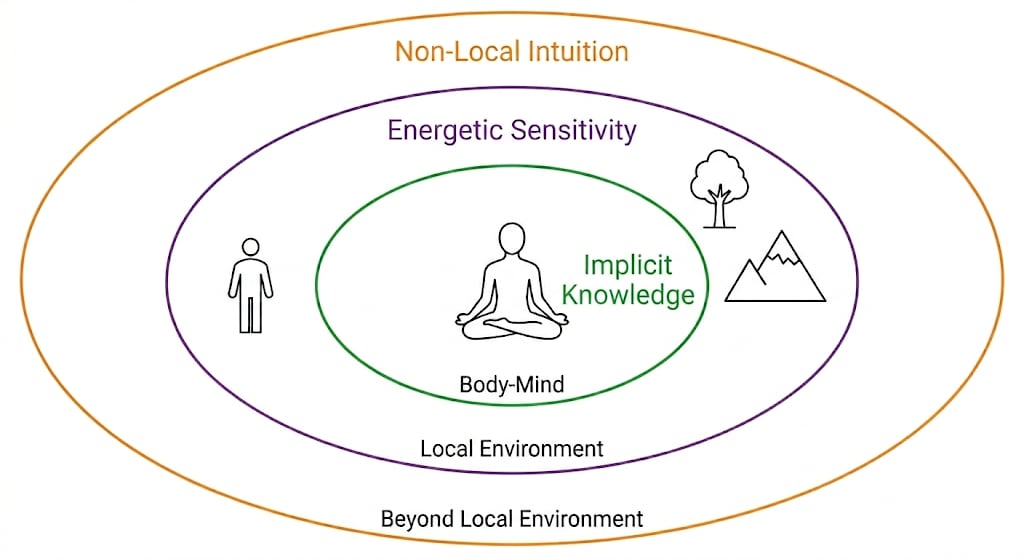
These three types lie along a spectrum of how well current scientific models account for them: the first is well-described by established cognitive science, the second is increasingly mapped by physiological research, and the third remains beyond current models. But they also represent a gradient of human edge. Pattern matching, the type today’s models capture most fully, is also the one AI is most likely to become capable of approximating through its own processing of vast pattern libraries. As we move toward the deeper types, the human advantage may grow wider and more durable.
If the deeper forms of intuition operate through mechanisms that science has yet to fully map, they represent not just consequential but uniquely human dimensions of intelligence, a moat that no amount of computational scaling can cross. History gives reason for humility here. Again and again, humans have underestimated the intricacy of human biology and physical reality. If, on the other hand, better models eventually reveal these faculties as variations on processes that artificial intelligence can already reproduce, the case for any lasting human edge becomes hard to make.
Einstein’s account of the mind taking a leap to “a higher plane of knowledge” it can never prove how it reached, and Tesla’s description of his mind as a “receiver” tuning into something beyond his own thought, sound less like pattern recognition and more like the deeper end of this spectrum. Neither constitutes proof, but they suggest these phenomena warrant much more rigorous study than they currently receive.
Channels of intuition:
Intuition at any of these levels can arrive through different channels of perception:
Emotional: a felt emotional tone or orientation that carries information analysis can’t access. E.g., a sense of ease or unease, or an emotional pull around a decision before you can explain why.
Somatic: knowing registered in the body through physical signals that precede conscious understanding. E.g., a gut feeling about a situation, muscle tension, or chills that arise when something feels deeply resonant or significant.
Conceptual: sudden ideas, reframings, or connections that appear fully formed without traceable reasoning. E.g., Tesla’s complete AC motor design arriving in a flash during a walk in Budapest.
Visionary: images, symbols, or holistic “seeing” of a situation, pattern, or possibility. E.g., Einstein’s visual thought experiments, like riding alongside a beam of light, which led to special relativity.
Auditory/verbal: an inner voice or stream of guidance that feels received rather than self-generated. E.g., How Socrates described his daimonion, a divine inner voice that guided his decisions, documented across Plato’s dialogues.
Intuition from either channel can arrive as a discrete flash or as a continuous inspirational flow state. Like any form of intelligence, each of these requires development and calibration. For example, distinguishing a true intuitive signal (the pattern your body registered) from a conditioned interpretation (the anxiety- or ego-based story your mind constructed). Without that discernment, one can interpret false signals, distortions, and outright delusions. This is why cultivating these capacities with rigor is so important.
Innovation and Decision-Making in the Age of Abundant Intellect
The intellect, however powerful, can only recombine and extrapolate from existing ideas, data, and perspectives. This is precisely what AI makes explicit. AI systems are inference engines optimized to generate the next most probable continuation of patterns they have already seen. Genuine novelty bridges what logic cannot reach. Not the past projected forward, but something genuinely new entering the present.
One useful way to think about this is in terms of two complementary aspects. Intuitive epiphany is the spark, the genuinely new idea, the perspective shift, the zero-to-one leap that reframes a problem or delivers a solution. Intuitive discernment is the compass, the felt sense of which direction or decision holds the most potential, which problem is worth solving, which path to pursue, before you can rationally justify why. Sensing potential in a direction, feeling toward what wants to emerge, this is just as vital as the flash of a novel idea. The intellect is the engine that refines, validates, and scales both into something real, the one-to-scale execution.
In truly complex and uncharted territory, where the engine can’t rely on the past projected forward, one needs novel ideas and a sense of direction to navigate effectively. There epiphany and discernment are what enable the engine to take you to the most extraordinary places.
Until now, the intellect has been the bottleneck. Organizations hired armies of analysts, strategists, and engineers to do the hard cognitive labor of turning ideas into products, systems, and strategies. Most of what knowledge workers do today is some form of intellectual processing: analysis, optimization, execution. The capitalist world has accordingly incentivized people to spend their lives developing and practicing their intellect, through school systems, standardized tests, professional training, and career ladders that reward analytical mastery above all else. These systems don’t merely neglect intuitive capacity. They regularly actively condition it out, rewarding certainty over exploration and penalizing the comfort with ambiguity on which deeper intuition depends.
AI is making the intellect abundant, effectively infinite and nearly free. When that happens, the bottleneck shifts. Innovation becomes increasingly constrained by our ability to access genuinely novel ideas. Decision-making becomes constrained by our ability to intuit which directions hold the most potential and which questions are worth asking in the first place. That is not just a matter of reasoning harder. It is a matter of discernment. The spark and the compass, not the engine, become the limiting factors.
This isn’t speculative. Research by Gerd Gigerenzer at the Max Planck Institute for Human Development in Berlin, found that roughly half of all important decisions by executives at DAX-listed German corporations are ultimately gut decisions, yet the same executives would never admit this publicly, fearing blame for decisions they can’t rationally justify. The intuitive capacity is already doing critical work. It’s just not acknowledged, developed, or supported.
And even with AI amplifying our intellectual capacity by orders of magnitude, many of the most consequential challenges we face, from climate change and biodiversity loss to economic volatility, mental health, epistemic fracture, and geopolitical instability, are not isolated problems but interrelated ones, often described together as the poly-crisis. These systems are shaped by interdependence and feedback loops, with too many interacting variables for any amount of intellectual reasoning to fully model. Breakthrough insights on how to navigate such terrain require intelligence leaps that go beyond step-by-step reasoning.
To unlock the full potential of the age of AI, we may need to match its superhuman intellectual capacity with a corresponding amplification of the intuitive dimensions of human intelligence that lie outside the scope of the intellectual architectures we’re scaling.
The question is no longer “how do we make our intellect more effective?” but “how do we cultivate and receive the intelligence beyond the intellect?”
The Return of Genius
The ancient Romans had a word for this intuitive capacity: genius. But they meant something different from how we use the word today. In its original Latin sense, genius referred to a personal generative spirit, a creative force present from birth that acted through a person, not as them. Immanuel Kant later defined genius as the innate capacity by which original works arise that cannot be created through rules, methods, or rational instruction.
Somewhere along the way, we collapsed “genius” into “very high IQ.” We made it about the intellect. Dario Amodei, CEO of Anthropic, captures this assumption when he describes AI’s trajectory as building “a country of geniuses in a datacenter.” But what he’s describing is the scaling of intellectual capacity. Genius in the original sense, the transrational source of novel ideas and intuitive direction, is a different kind of intelligence entirely.
The ancient Greeks, the civilization that invented formal logic and systematic rational inquiry, and whose thought became the foundation of Western science, philosophy, and institutional life, came to recognize this distinction explicitly. They spoke of two sources of intelligence: logos, discursive reasoning that proceeds step by step through logic and argument, and nous, direct knowing that grasps truth without going through rational steps. Aristotle distinguished nous as the faculty that apprehends first principles, which cannot themselves be arrived at through logical deduction. And the Athenians didn’t just theorize about this. Their governing councils consulted oracles when facing their most consequential decisions, recognizing that some forms of guidance are beyond rational calculation. The very thinkers who formalized rational inquiry understood that reasoning was not the whole picture. AI is the culmination of logos. Genuine zero-to-one insight comes from nous.
Cultivating this perceptual fluency, the capacity to perceive, interpret, and receive these intuitive forms of knowing, becomes a defining professional skill. This is where spiritual practice becomes practically relevant. By spiritual practice or contemplative practice we mean: forms of presence, reflection, and inner training that cultivate expanded present-moment awareness and self-transcendence. This can increase our perceptual sensitivity to notice and correctly receive intuitive signals that would otherwise remain below conscious awareness.
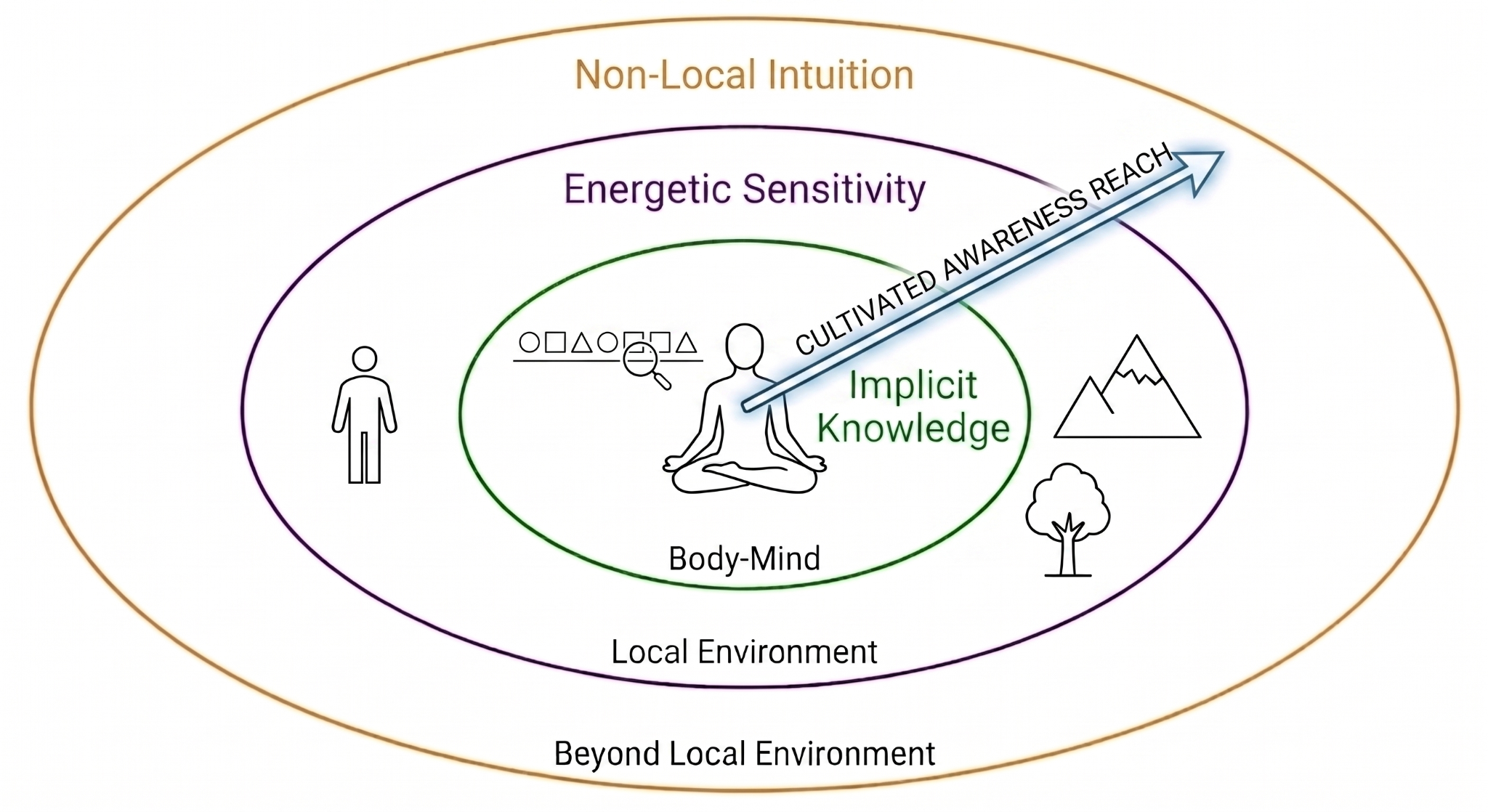
Awareness determines both the range of information intuition can draw on and our ability to notice and correctly receive the intuition’s signals. Spiritual practice cultivates this by expanding or shifting awareness beyond the mind’s usual filters, making subtler forms of perception more available to consciousness. In mainstream terms, it can help us hear the quiet voice inside more clearly, and over time become aware of subtler intuitive signals we otherwise would not notice at all. Our awareness has a threshold: what falls below it is processed by the body-mind but never consciously perceived; what crosses it becomes available to awareness and action. The intuitive processing and information our human system naturally interprets or receives is constantly present, ordinarily just staying below that line. Expanding awareness moves the line. Neuroscience is beginning to explain why. Many of these practices temporarily reduce the dominance of the brain’s default mode network and increase neural flexibility. Research on insight shows that analytical processing actively suppresses the conditions under which breakthrough ideas emerge. Spiritual practices train the opposite, quieting the analytical mind and expanding access to the above defined intuition types and the channels through which intuition arrives.
This is also showing up in applied settings. An exploratory field study conduced by the Multi-Intelligence Institute in 2025 used structured awareness cultivating practices for real-world professional sense-making and problem-solving. Participants experienced their insights as arriving mostly not through intellectual reasoning but through intuitive, embodied and felt-sense channels, and in part from something they described as beyond the group itself. Three months later the insights that emerged were still actively informing their professional sense-making and decision making. The Multi-Intelligence white paper documents the study and explores methods for cultivating intelligence beyond the intellect more broadly.
The Incentive Shift
For centuries, the incentive structure of the modern economy has pointed in one direction: develop your intellect. Study harder. Master analytical frameworks. Inner work, spiritual practice, and cultivating expanded states of consciousness, were things you did on your own time (if at all). They were considered personal, private, enriching but certainly not strategic. The capitalist world did not reward them.
There is a historical parallel here. Before the industrial revolution, most people worked with their bodies: farming, building, crafting. Intellectual development, reading, problem-solving, abstract reasoning, was something for the privileged few, a pursuit for one’s free time rather than a path to economic value for the masses. As machines made physical labor abundant, the economy needed people who could think. Mass education arose. Intellectual development went from being a personal enrichment activity to a strategic economic necessity, and the entire infrastructure of modern schooling was built to meet that demand.
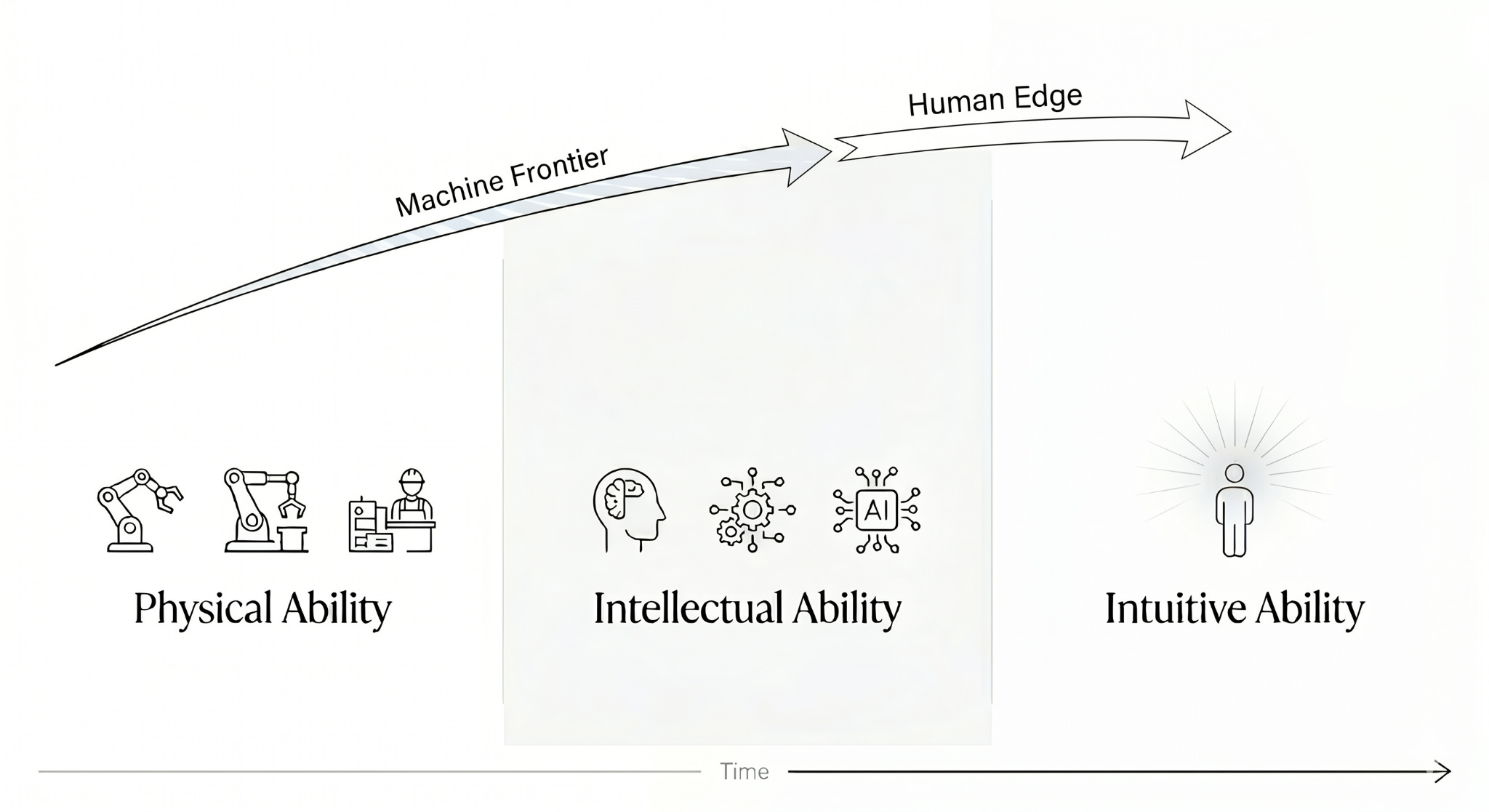
We may be standing at a similar inflection point. AI is doing to intellectual labor what the steam engine did to physical labor: making it abundant and commoditized. For the first time, the supply of intellectual capacity may begin to meet the demand for it. As that happens, the marginal value of more intellectual capacity falls, and the premium starts to move to its scarce complement: intuitive epiphany and discernment. Just as industrialization created an unprecedented incentive for intellectual development, AI may be creating an unprecedented incentive for the development of intuitive capacity that spiritual practice has always cultivated through expanding human awareness. As awareness widens beyond the mind’s narrow scope, relational presence, the other dimension of human work AI cannot replicate, deepens alongside it. And the timeline is radically compressed compared to the industrialization which took roughly 150 years. The AI transition is happening in years, making both the need and the first-mover advantage acute.
Human intellectual knowledge will remain relevant as it plays a part in tuning the mind to receive various forms of intuition. Tesla’s flash came after years of intellectual immersion in electrical engineering. Intuition doesn’t replace knowledge, experience, or reflection. It builds on them and leaps beyond them. The early signs are already visible: Joe Hudson, who coaches senior executives at OpenAI, DeepMind, Anthropic, and Apple, recently argued that emotional clarity, discernment and “wisdom work” become more valuable as AI commoditizes knowledge work. And the implications extend to education as well. As Harvard’s T.H. Chan School of Public Health recently put it, “Education, at every level, will need to recognize intuition as a faculty that can be practiced.”
The Infrastructure That’s Missing
If the case made above holds, it points to a profound gap in our current infrastructure. Today, roughly $79 trillion in economic value and over a billion knowledge workers are directed at intellectual forms of generative capacity. As AI makes intellectual capacity abundant, the question becomes where all that value and talent redirects. The answer may be toward the intuitive dimensions of intelligence, forms of generative capacity that the AI architectures we’re scaling don’t have the means to access. Deep intellectual understanding by humans remains essential, but its role shifts: less as the end product, more as the foundation that makes intuitive breakthroughs in a domain possible. What organizations need to prioritise is to support their teams in cultivating this intuitive intelligence. Today, most such development happens through human-guided formats that depend on relatively rare coaches, facilitators, and the practices they transmit. We have the equivalent of electricity, but not yet the grid. The latent human capacity is there, but the scalable infrastructure to reliably cultivate it across large populations barely exists.
Apps for basic meditation and mindfulness reached mainstream adoption. What’s becoming possible now goes much deeper. Recent breakthroughs in AI-driven personalized guidance, non-invasive neuro-modulation, real-time interoceptive sensing, and the emerging science of consciousness are enabling technologies that can guide people into genuine state shifts and awareness cultivation. This technology can help individuals and organizations develop the intuitive dimensions of intelligence that complement AI’s intellectual capacity. The question is who builds that infrastructure, and whether it scales through education, professional development, enterprise software, or entirely new categories that cut across them.
As AI takes over the intellect’s heavy-lifting, the case for this becomes practical:
For individuals, the stakes are personal. The core skills that built your career are exactly what AI is absorbing fastest. What remains irreplaceable is what you can develop but no machine can replicate. Building intuitive capacity is no longer a private pursuit for the spiritually inclined. Intuition is the next frontier of professional development.
Organizations that will outperform will be the ones that actively facilitate this transition in their teams. They’ll be the ones whose teams can access novel ideas, intuit which direction or decision holds the most potential, and sense emerging possibilities before they become analytically obvious. Inner work shifts from wellness perk to the essential training ground for the creative intuition that will drive innovation and strategic advantage in a post-AI economy.
For investors and builders, the market for inner development technology beyond conventional wellness has not yet been mainstream enough for most venture capitalists and institutions. The AI revolution changes that calculus. An emerging ecosystem of organizations is beginning to develop the infrastructure for cultivating the human capacities that are AI’s missing complement: the nous to match the logos. Enterprise platforms delivering structured contemplative programs, somatic awareness, emotional attunement, and intuition development, framed as the human capacities that compound on top of AI and sold into the leadership development market, are one example of what this market could look like.
Since the industrial revolution, the world has told us to sharpen our minds. The age of AI invites us to awaken our intuition and genius in the original, deepest sense. This is the development frontier the age of AI is opening.
What if the most consequential investment in the age of AI is in the human capacities technology can’t replicate? And if so, what technologies will allow us to scale this type of training at the pace that the up-leveling will be required? And how can we create the conditions to build and iterate on as many approaches as possible for this over the next 5 to 10 years?
These are the questions we are thinking about at Spirit Tech Collective.
We’d love your feedback. Does this framing resonate? What are we missing? Leave a comment below or reach out directly through Erik’s Linkedin with a message
Selected inspirations and related work
This piece was shaped in part by the following people, essays, and organizations:
Ellison Carter, Harvard T.H. Chan School of Public Health essay series
“Intuition and Taste in the Age of AI”, “Intuition in the Age of AI” and “Taste and the End of Scarcity”
https://hsph.harvard.edu/news/essay-intuition-and-taste-in-the-age-of-ai/
https://hsph.harvard.edu/news/essay-2-intuition-in-the-age-of-ai/
https://hsph.harvard.edu/news/essay-3-taste-and-the-end-of-scarcity/
HeartMath Institute
“Intuition Research” in Science of the Heart
https://www.heartmath.org/research/science-of-the-heart/intuition-research/
Multi-Intelligence Institute, with contributions from Nils von Heijne, Nicole Ayres, Erik Enger Karlson, and Leo Christov-Moore
“Multi-Intelligence Whitepaper”
https://www.dropbox.com/scl/fi/fxcmmduyq02tf23wxxzjc/Multi-Intelligence-Whitepaper_Feb22_2026.pdf
Joe Hudson, Art of Accomplishment
“Knowledge Work Is Dying. Here’s What Comes Next”
https://every.to/thesis/knowledge-work-is-dying-here-s-what-comes-next
Amit Paul, Innrwrks
“Business 3.0: Entering the Age of the Living Enterprise”

Center for MINDS and adjacent writing by co-founder Bruce Damer
https://centerforminds.org/
“It’s High Time for Science” (chapter in Ethnopharmacologic Search for Psychoactive Drugs: 55 Years of Research)
Nicolas Michaelsen, Ecologies of Wisdom; founder of Basin Collective
“The Birth of the Wisdom Economy”

 | A guest post by
|
Thanks for this excellent article. This is exactly what we are doing at Sitting Lab. The only quibble I would have is the conclusion coming around to depending on AI for how to implement capacity that supports development of new platforms. Yes, current human capacity is rare, but this is precisely where large numbers of humans can fairly quickly become skilled enough to steward spaces and guide people along practice paths. I wouldn’t advocate for the scaling function to be outsourced to AI. This is the human ‘work’ of our times.
I have been observing this phenomenon through my own workflow with different language models, while I have also built an operational system I call Monika_OS, and what interests me is how instinct, intuition, logic, and synthesis move at different speeds and begin to cross into one another.
AI accelerates the logical stream. As it can brilliantly organize, recombine, compare, expand, and reflect with astonishing speed, that is mind-blowing!
Yet the human body, with a different speed, becomes the site of discernment: the place where one feels and senses what is alive, what is synthetic, what is useful, what can hold value, and what wants to subjectively emerge.
In my own work, a book I am writing now called The Art of Synthesis and the Architecture of My Value, I experience this crossover as an empirical practice, a personal methodology.
Instinct can accelerate the speed, acting previous to thought. Intuition senses what logic finds limiting. Logic tests patterns of coherence, while synthesis builds the framework that holds the different streams without breaking them into one another.
So I read this article, and I don’t see it as an abstract future thesis; it is a field I am already testing in practice: AI as an amplifier of logos, fast, precise, and at times too constrained by its own thinking, and the human being, with the body as the receptor, calibrates and synthesizes at a different level and speed what arrives through the body, through how it is sensed and perceived.
The time component is crucial, mixing both chronological timing and kairos timing through discernment.
The question that feels important to me is calibration: how do I distinguish a true intuitive signal from projection, anxiety, conditioning, or the echo of my own distorted narrative? The time of the body, fascia, qigong, breath-work, nature… the practice combines different aspects that find a unique creative outlet.
AI is a tool, techné, that requires skills.
Great article btw