
What Will It Take to Build Technology That Honors the Sacred?
Building towards a venture model where capitalism serves the sacred, not the other way around


Spirit Tech: Field Notes from the Edge is a newsletter written by members of the Spirit Tech Collective (STC). Inspired by the Climate Tech movement, STC’s mission is to 50x the funding and talent flowing into the Spirit Tech sector over the next 10 years, paving the way for greater collective wisdom and flourishing. Our aim with this newsletter is to share the synthesis of our research for feedback as we collectively cultivate the soil to usher in the next wave of Spirit Tech innovation.

In our last article, we shared an early vision for what spiritually aligned infrastructure for Spirit Tech could look like. Over the past few months, we have spoken with founders, funders, spiritual teachers, and ecosystem builders to deepen our thinking on a core question:
How can we catalyze an economically thriving Spirit Tech sector while helping founders place spiritual integrity at the heart of the innovation cycle and minimize soul drift as they scale?
This article shares a more developed answer and outlines the ecosystem infrastructure we plan to build through the Spirit Tech Foundation over the coming years.
We know many others across different sectors are asking similar questions. Our hope is that this piece contributes new ideas to the broader dialogue.
Everything here is an early stake in the ground.
We invite you, as the reader, to build on these ideas, share feedback, and if you feel called to play a role in the ecosystem we are shaping, we would love to hear from you
Setting the Context
Modern society has made extraordinary progress by focusing on technical systems change. We have built powerful tools, and institutions that have improved many facets of human life.
At the same time, we are reaching a breaking point. Our systems are no longer producing the kind of society many of us want to live in. We continue to optimize them without addressing the deeper forces that shape how they are designed, governed, and used.
Those forces are upstream.
Systems are created by people, and people act from their inner foundation and values. To truly transform the systems that shape our society, we must re-emphasize inner transformation as a complement to our ever-growing technical capacity and power to catalyze outer change.
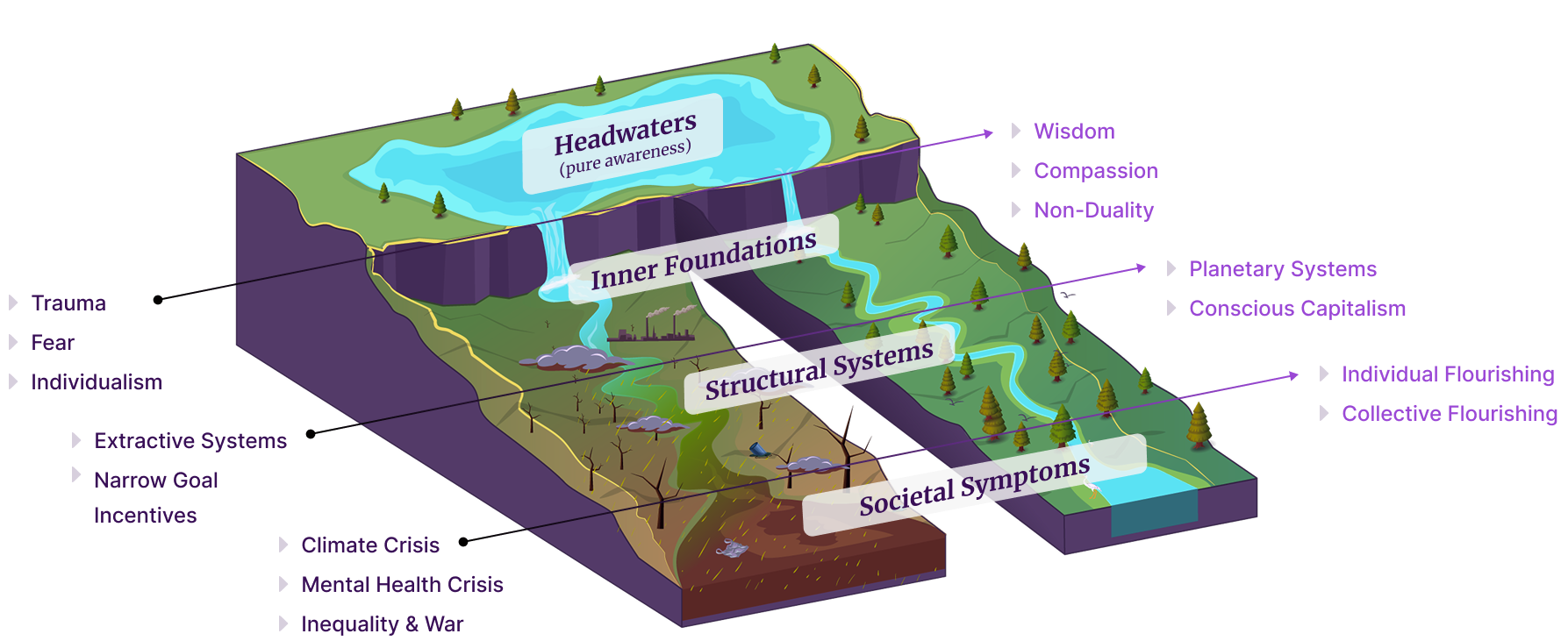
Throughout history, and now increasingly supported by scientific research, experiential and embodied spiritual practice has been one of the most durable ways humans have developed this inner foundation. It does not replace technical skill. It shapes how that skill is applied.
For the first time, technology, if designed and used wisely, may be able to support this inner work at meaningful scale. As outlined in a previous article, recent technological breakthroughs have opened a real opportunity to support inner development in new and powerful ways.
From this perspective, an important question emerges:
Can modern technology support spiritual development and inner transformation at scale, and help humanity move toward greater wholeness and connectedness?
If we take the perspective outlined above seriously, this becomes one of the most important questions of our time. And yet, Spirit Tech remains remains profoundly under-resourced, underfunded, fragmented, and largely invisible to world-class technical and entrepreneurial talent.
The Spirit Tech Foundation exists to change that.
Our vision is to seed 100 Spirit Tech ventures over the next decade and support millions of people through a transformative inner journey and live more aligned lives.
But financial capital alone is not enough.
Done well, Spirit Tech can support deep transformation, healing, connection, and wholeness. Done poorly, it risks accelerating spiritual consumerism, bypassing, hyper individualism, and new forms of dependence. Screwing up a grocery delivery is a minor inconvenience. Pushing someone too fast on a spiritual path can alter a life in profoundly harmful ways. The growth-at-all-costs incentive model which has driven rapid innovation across most sectors is uniquely dangerous in Spirit Tech.
Ram Das famously said, “Ego is a beautiful servant, but a terrible master.” In a similar way, capitalism is a powerful servant, but a terrible master.
This brings us back to our core question:
How can we catalyze the Spirit Tech sector while placing capitalism in service to spirit, rather than having our spirit serve capitalism?
Defining Spiritual Integrity
To make spiritual integrity more concrete in the context of technology innovation, we developed an early draft of what we call no-go clauses. These clauses are intended as a shared manifesto embedded at the heart of the sector.
At their core, they are designed to protect user sovereignty and ensure safety, dignity, privacy, and deeper spiritual wellbeing are upheld, regardless of business model or financial incentives.
This is a very early draft. Over the next 12 months, these principles will be refined with founders, funders, wisdom teachers, tested in practice, made more concrete, and translated into a clear standard for the sector.
No state alteration without safeguards: We will not deploy technologies that alter consciousness or wellbeing without safety protocols, risk disclosure, and integration support.
No misuse of sensitive inner data: We will not sell behavioral, biometric, emotional, or spiritually relevant data beyond what is strictly required to deliver the core product experience.
No exploitation of vulnerability: We will not use fear, urgency, shame, or emotional or spiritual vulnerability to drive engagement, retention, or conversion.
No forced pacing: We do not push users toward intensity that exceeds their readiness in order to drive engagement. We do not undermine a user’s inner knowing of what is right for them.
No designed dependency: We will not engineer for addiction or lifelong reliance. Success may mean users outgrow the product.
No false universality: We will not claim our approach is right for everyone or diminish other traditions, paths, or ways of knowing.
No false or inflated claims: We will not promise or imply guaranteed healing, awakening, enlightenment, or spiritual transformation. We will not oversimplify, exaggerate, or selectively present spiritual traditions or scientific research to support product claims.
No cultural extraction or appropriation: We will not remove practices from their cultural contexts, misrepresent lineages, or profit from traditions without proper attribution, consent, and reciprocity with source communities.
No exploitation of power asymmetries: We will not leverage the authority of teachers or guides to extract value beyond fair exchange and ensure those in positions of authority hold verifiable credentials and submit to recognized standards of accountability.
No spiritual bypassing by design: We will not engineer experiences that use spiritual concepts to help users avoid psychological work, difficult emotions, or face necessary life challenges.
Even the most well-intentioned founders struggle to uphold principles within the current tech ethos. Over the past decade, many successful Spirit Tech founders have fallen victim to the pressures of growth-at-all-costs capitalism and have compromised on their core values. There are even terms for it now: mission and soul drift.
In our current system, this is an inevitable outcome. Without the right structures, it is legally impossible at times to maintain integrity. At the same time, no external governance mechanism is sufficient if the leaders building these technologies lack embodied discernment in moments of stress, growth, and uncertainty.
Embedding Spiritual Integrity into Spirit Tech
Embedding spiritual integrity at the heart of the Spirit Tech ecosystem to counterbalance growth-at-costs capitalism will require a multi-pronged approach.
This is not something we are imposing. Spirit Tech founders are actively asking for support.
“From a company standpoint, every single place where there could be a lack of integrity — all those holes need to be filled. Governance is key. I want somebody to open up the hood of ABOVE and be like, ‘holy shit — these guys have literally thought about every possible way that they could not be doing something in integrity, and they’ve figured it out.’”
— Lyle Maxson, CEO of Above
Over the past year, we interviewed many founders to understand the challenges they face in this emerging sector. Two themes came up consistently.
First, access to aligned capital. Many early-stage founders hesitate to raise conventional venture capital. Those who do, often attempt, mostly unsuccessfully, to design bespoke governance structures to protect mission, without adequate legal or advisory support.
Second, a lack of community and peer support. As a nascent sector, Spirit Tech lacks the shared infrastructure that founders in more mature ecosystems take for granted. Many founders feel isolated and under-supported while navigating high-stakes decisions alone.
As the first institutional investor dedicated exclusively to Spirit Tech, we want to fill these gaps. In addition to $1M of capital, every founder backed by the Spirit Tech Foundation (STF) will receive the following ecosystem level support:
Governance Support: STF makes it as easy and cost-efficient as possible for Spirit Tech Founders to set up mission-lock governance from Day 1
Hands-on advisory support and shared templates in 3-months post investment
Access to a third-party governance body to support implementation and long-term stewardship
Mentorship, Advisory, and Peer Support: STF will surround founders with a trusted circle that supports discernment and creates healthy accountability when it matters most.
Dedicated one-to-one spiritual mentorship from a trusted teacher
A small peer mastermind of six Spirit Tech founders facing similar challenges
Access to a broader advisory network across science, fundraising, technology, go-to-market, media, and spirituality
Field: STF will cultivate the cultural and relational conditions that make spiritually aligned innovation easier to sustain over time.
A shared ecosystem container stewarded by a Wisdom Council
Monthly practice and learning sessions focused on embodied leadership and discernment
Invitation to an annual Spirit Tech gathering for the founder community
For this model to work, we must demonstrate that spiritual integrity is a real competitive advantage.
Our hypothesis is that this integrated support increases the likelihood of both commercial success and positive impact. In practice, founders gain:
Stronger trust signals with users, partners, and investors
Meaningfully reduced risk of mission drift, regardless of future capital pathways
Clearer decision-making under pressure
Greater resilience, reduced burnout, and healthier teams
Validating these outcomes will be our core focus over the first two to three years.
The Founding Field
To support founders at this depth, we are convening what we call the Founding Field. It is an interlocking system of councils, committees, and advisors that work in relationship to support Spirit Tech founders. Each body holds a distinct responsibility, while staying synchronized around a shared commitment to spiritual integrity.
At the center of the Founding Field are four interdependent bodies:
The Wisdom Council (WC): spiritual grounding, discernment, and field coherence
The Governance Council (GC): shared legal governance entity for the sector
The Investment Committee (IC): guide capital allocation and support fundraising
The Board of Directors (BoD): fiduciary oversight for the Spirit Tech Foundation
Each council will begin with three members and grow gradually as the portfolio expands.
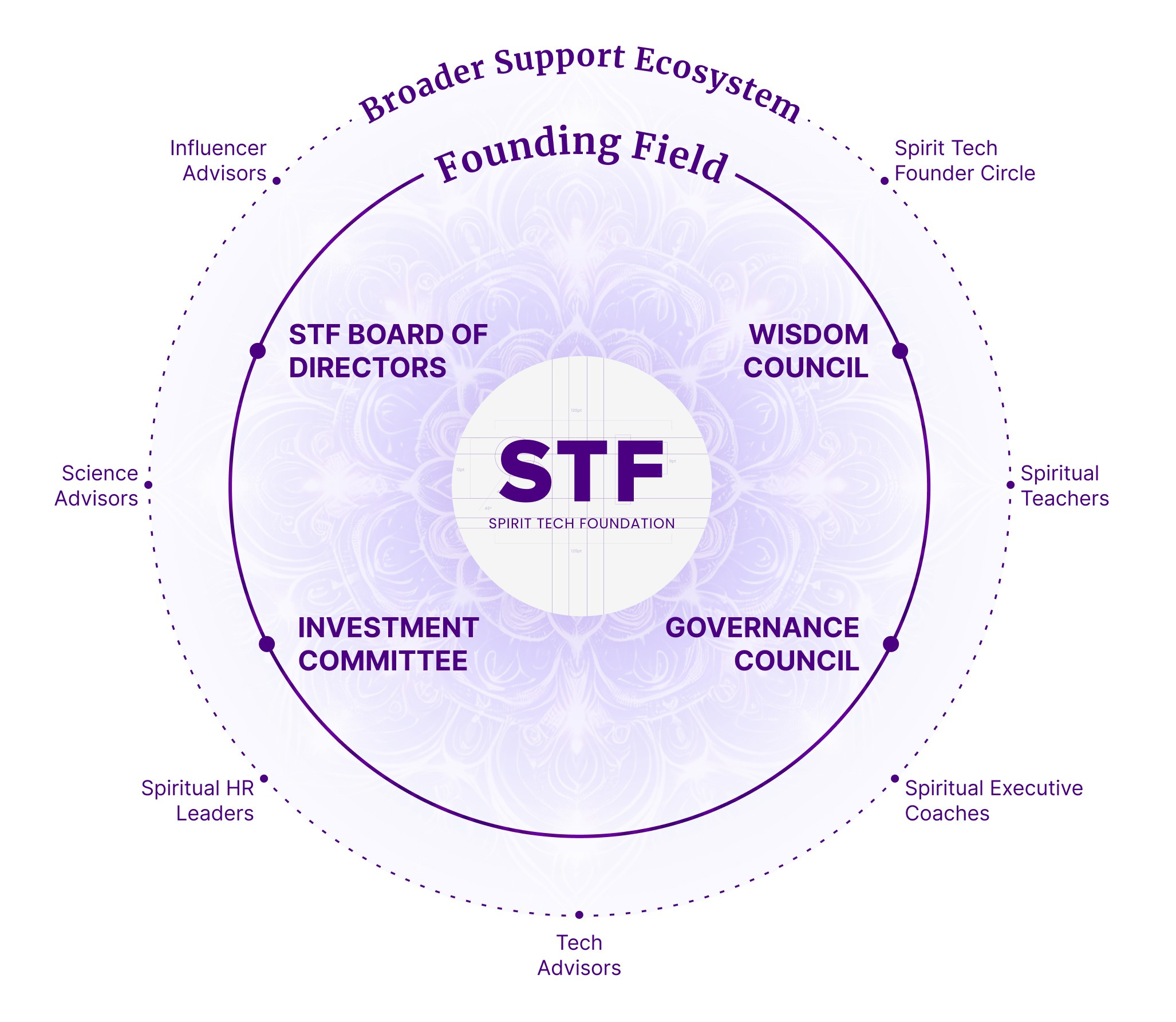
While this structure may appear complex, distributing responsibility across councils reduces friction and improves clarity. This article focuses on the Wisdom Council and Governance Council, which form the core stewardship layer.
Role of the Wisdom Council (WC)
The WC will serve as the primary coherence and spiritual grounding anchor for the ecosystem. It will be composed of spiritual leaders and teachers who embody spiritual depth and maturity.
The Wisdom Council does not “hold the field” on behalf of founders. Its role is to offer what John Churchill describes as a sacred–secular operating system, and to help founders develop the capacity to hold the field themselves as they build and scale.
Members of the WC are well respected spiritual teachers with the capacity to:
Support founders in cultivating internal coherence and discernment
Sense when decisions, incentives, or trajectories are drifting out of alignment
The WC will lead the core field-building rhythms of the ecosystem, including a monthly coherence call and an annual in-person gathering. It will play a central role in founder mentorship through the triad structure described below and in supporting the other councils in key decision moments.
Over time, the WC will serve as a signal and beacon of trust, supporting founders in building confidence with partners, funders, and end users.
Role of the Governance Council (GC)
One of the core functions of the STF will be to make it as easy and affordable as possible for early stage founders to implement governance structures that protect mission and spiritual integrity at scale.
There are multiple legal governance models that support mission lock and long-term alignment. A comprehensive overview of these models has been recently published by Halcyon Futures and I will not repeat them here.
During the investment process, the GC will work with each founder to identify and implement the governance structure that best fits their ambition, risk profile, and expected capital pathway. Many of these models require a trusted third-party oversight body. The GC serves this role as a shared governance steward specifically for the Spirit Tech ecosystem. This approach allows founders to implement strong mission-protection mechanisms without needing to create bespoke oversight structures for each company.
To make this more concrete, a typical governance stack might include:
Structuring the company as a Public Benefit Corporation (PBC) with a clearly defined public mission
Defining explicit no-go clauses in the charter based on shared spiritual integrity principles
Creating a Golden Share, with narrow veto rights over changes to mission or no-go clauses, held by the Governance Council as a trusted third party
In this structure, no investor or external stakeholder can force actions that violate the company’s mission or integrity commitments, even if a founder later loses control of the company.
How These Bodies Work Together
Operational coherence is maintained through:
A monthly cross-committee coherence call led by the Wisdom Council
An annual three-day in-person gathering for councils, advisors, founders, and funders
A triad support structure for founders
Each founder is supported by a triad composed of:
One Wisdom Council member
One Governance Council member
One Investment Committee member
Each triad maintains a multi-year relationship with a group of seven founders and provides up to two hours per month of one-to-one support across spiritual, governance, and business dimensions.
Selection Criteria for Founding Field Members
The success of this effort will depend on selecting the right people.
While each council has role-specific requirements, the following criteria apply across all councils:
Impeccable reputation: no credible allegations of misconduct, a transparent lineage or training path, and a demonstrated capacity for humility and accountability.
Deep spiritual practice and grounding: a lived, embodied relationship to practice that informs how one shows up, not just what one believes.
Trans-lineage orientation: while founding field members may be rooted in at one tradition or path, they are able to sit alongside other maps with genuine respect and curiosity.
Shared context window: basic fluency with technology, startup dynamics, and capital flows, without holding fixed anti-tech or anti-capitalist positions.
Mentorship or teaching experience: a proven ability to support the spiritual or developmental growth of others over time.
Low ego and high relational maturity: able to collaborate across difference, hold power cleanly, and keep personal agenda out of collective decision-making.
Minimal commercial conflict: not actively building or materially invested in Spirit Tech ventures in ways that could compromise neutrality.
Long-term commitment: able to consistently commit the required time and show up with continuity over a 5–7 year horizon, including meetings and periodic retreats.
Wisdom Council: 6–10 hours per month
Investment Committee: 10–15 hours per month
Governance Council: 15–25 hours per month
Board of Directors: 4–5 hours per month
A core focus for the first half of 2026 will be recruiting the initial members of the Founding Field.
We already have a strong pipeline of potential members and will continue to deepen it over the coming months.
We welcome your input. If you are a Spirit Tech founder, who would you want to see on each of these councils? We also welcome self-nominations. Please share any referrals directly by email: eddyvaisberg@gmail.com
Sustainable Funding Mechanism
Our intention is to design a compensation model that honors the spiritual and relational labor of the Founding Field while remaining sustainable by design. Every member of the Founding Field will receive annual compensation in recognition of their time, care, and responsibility.
To support this infrastructure, the Spirit Tech Evergreen Fund will invest $1.11M into each company in exchange for equivalent equity. Of this amount, $1M is deployed directly into the company, while $111k will be allocated to the Foundation to provide spiritual integrity infrastructure.
This provides founders up to seven years of integrated support for roughly 1–2% equity (the equivalent of one strong advisor), with no cash outlay, while allowing the Foundation to operate sustainably.
An Invitation
We hope these ideas contribute to the broader conversation about how technology can be built with a different set of principles, even within today’s economic system.
Getting this right matters not only for Spirit Tech, but as an early experiment that may inform other sectors as well. If you would like to be involved in shaping this work, please leave a comment and we will follow up.
Our focus for the first half of 2026 is to:
Collaborate with ecosystem builders to refine these ideas
Recruit the initial Founding Field members
Interview founders and funders to gather structured feedback
Our intention is to convene the Founding Field toward the end of Q3 2026 and launch the MVP of the ecosystem infrastructure in early 2027.
Thank you to Kalia Lydgate for being a key thought partner, and to Amanda Efthimiou and Andrew Dunn for their feedback throughout the proce.
Thank you for writing this. I do resonate with the essence of what you're proposing. A few thoughts:
on "No state alteration without safeguards": all technologies alter the state of the users
on "No designed dependency": what comes to mind is this piece from Sep Kamvar's beautiful book Syntax & Sage:
[[To me, one of the most startling and beautiful properties of our bacteria is their intricate ability to keep themselves in check. Let's take, for example, bifidobacteria.
This species of bacteria lives in our gut and secretes acetic acid, which in turn breaks down the carbohydrates we eat and protects us from certain infections. Remarkably, and luckily for us, the acetic acid produced by our bifidobacteria also keeps them from growing out of control. When the environment gets too acidic, they don't reproduce.
Perhaps I shouldn't be too surprised by this feat of selflessness. Relationships tend to develop a rich texture as they mature, and we and our symbiotic bacteria have been going at this for some time now. I'm reminded of an older couple, where both partners have their quirks, but each knows how far to go, when to pull back, and what to tolerate; where each knows the other so well, and is so dependent on the other, that it's hard to tell where one person stops and the other begins.
The relationship between us and our technologies is newer, like a younger love. It's fiery and exciting, and we're still learning our boundaries. Technologies, like most things, have natural limits to their utility. Up to a certain point, e-mail makes us more efficient. After that, the mounds of e-mail in our inbox take time away from our real work. Up to a certain point, time spent on social networks brings us closer to our friends. After that, it takes away from time we spend with them in person.
Which brings us back, again, to our bacteria. If we want tools that respect their natural limits, we can design limitation into the tools themselves.
If the idea of self-limiting tools seems antithetical to technology and capitalism, let me suggest that we already build them. A search engine is a self-limiting tool. As is an online dating site. When these tools succeed, people leave the site. Video games and TVs, on the other hand, are self-reinforcing. Their use doesn't lead to disuse; their use leads to more use.
The more self-reinforcing a technology is, the more likely we are to use it at our own expense. On the other hand, the more self-limiting a technology is, the more likely it is to die out.
The key is to find the balance.]]
on "No cultural extraction or appropriation": a key nuance here is that cultural contexts are inherently permeable; culture is not a closed system. Meanwhile, even the notion of lineage or cultural tradition is continuously constructed in the present as a process of relationship with the world today, rather than received as a static self-existent object from the past to be preserved. To me this is particularly clear in the context of present-day tribal identity and history-making in Amazonian peoples who serve ayahuasca to "northerners".
on "No spiritual bypassing by design": this is also tricky, because the assessment of whether a life challenge is "necessary" itself depends on the spiritual/meta-physical orientation; aside from institutional force, there is not a priori a normative "correct" answer.
.
Anyway, I do appreciate what you're proposing... as a practitioner/teacher, biologist, and occasional writer on metaphilosophy of technology (etc.), I'm also curious about collaborative potentials.
Wow. This is beautiful, have I at last found my family of TechGnostics?
I am working in parallel with you guys; from code to structure - spirit is baked into every article.
I appreciate your vision for PBCs — and I'd invite you to explore an alternative architecture: a sacred trinity model operating in Private Jurisdiction.
When I built SoilDAO, we created the first DAO structured as a Private Membership Association (PMA), operating as an auxiliary of the Temple of Soil — a 508(c)(1)(a) faith-based organization. The result: governance that exists outside statutory jurisdiction entirely. No SEC. No state entanglement. Just members, covenants, and divine law.
The trinity: PMA (membership & governance) + Faith-Based Organization (spiritual foundation & tax status) + Private Express Trust (asset protection & treasury).
More here: https://endogon.substack.com/p/from-dao-to-pma-building-soildao
Since then, I've been building tools for this sovereign future:
MegaMem — Persistent AI memory for Private LLM & data trusts
TrustWise — Agentic builder for private express trusts
MyFutureSelf Protocol — A bootstrap paradox for AI-assisted goal achievement (which just might change your life forever): https://endogon.substack.com/p/myfutureself-protocol-a-bootstrap
You invited readers to self-nominate for the Founding Field. Consider this my hand raised. I've stress-tested these governance structures in the wild — and I'd be honored to bring that experience to your Governance Council. Let's talk.
— Casey Bjørn, TechGnostic at Endogon